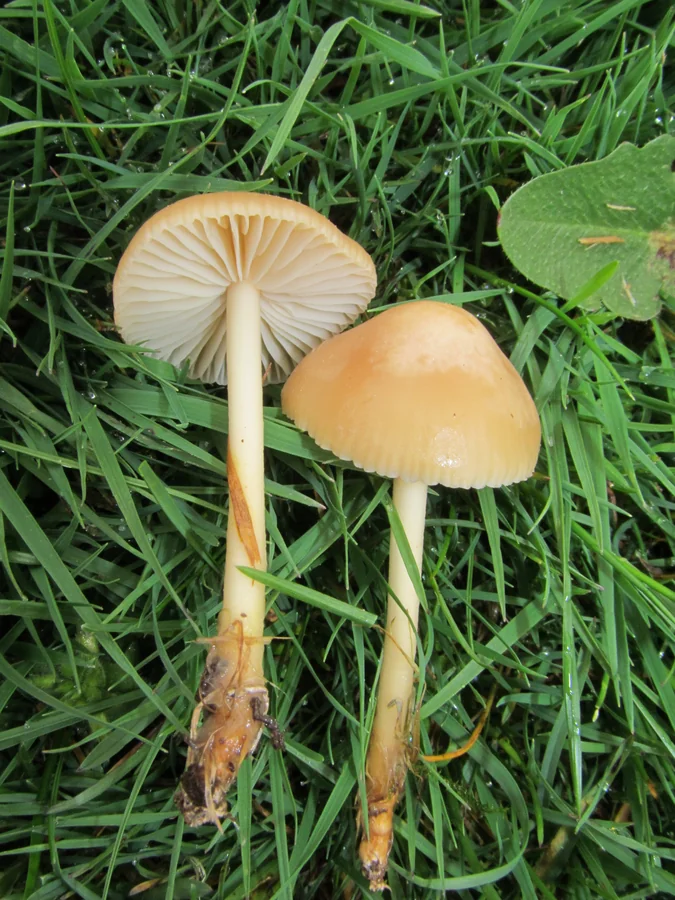
Fairy ring champignon
Marasmius oreades · 硬柄小皮伞
Common小皮伞科🍽 Reported Edible (Wild)
Reference sources describe this as an edible wild fungus. This guide provides no basis whatsoever for foraging or consumption.
The same species can be described differently across regions and stages of maturity, and countless look-alike species cannot be told apart by eye. Never use the information on this page to judge whether a real mushroom is safe to eat.
How to Tell
- Cap pale brown, bell-shaped, with a slight central bump
- Gills sparse; stem thin and tough, bends rather than breaks
- Forms arcs or rings on lawns
ID notes are compiled by AI from public sources, not reviewed by a mycologist, for learning only — never a basis for foraging.
Basics
- Family
- 小皮伞科
- Hymenium
- Gills
- Grows On
- Grassland
- How Big
- 2–5 cm (cap diameter)
- Encounter Rate
- Common
- Habitat
- Lawns and pastures, often in rings
Easily Confused With
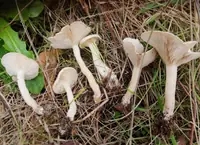 Ivory funnelFairy ring champignon has a pale brown bell-shaped cap, sparse non-decurrent gills and a tough stem; ivory funnel has a frosted white cap and decurrent gills.
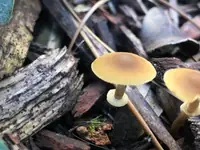 Deadly conecapFairy ring champignon has no ring and sparse white gills; deadly conecap has a membranous ring and rusty-brown gills.
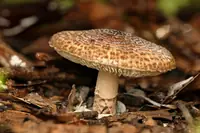 Deadly dapperlingFairy ring champignon has a smooth, scaleless cap and a tough stem with no ring.
Fun Fact
The 'fairy rings' on lawns form as mycelium spreads outward from a single point at a steady rate, growing the ring by roughly ten centimeters a year — the oldest rings are centuries old.
Open in the guide · filters & photos ›