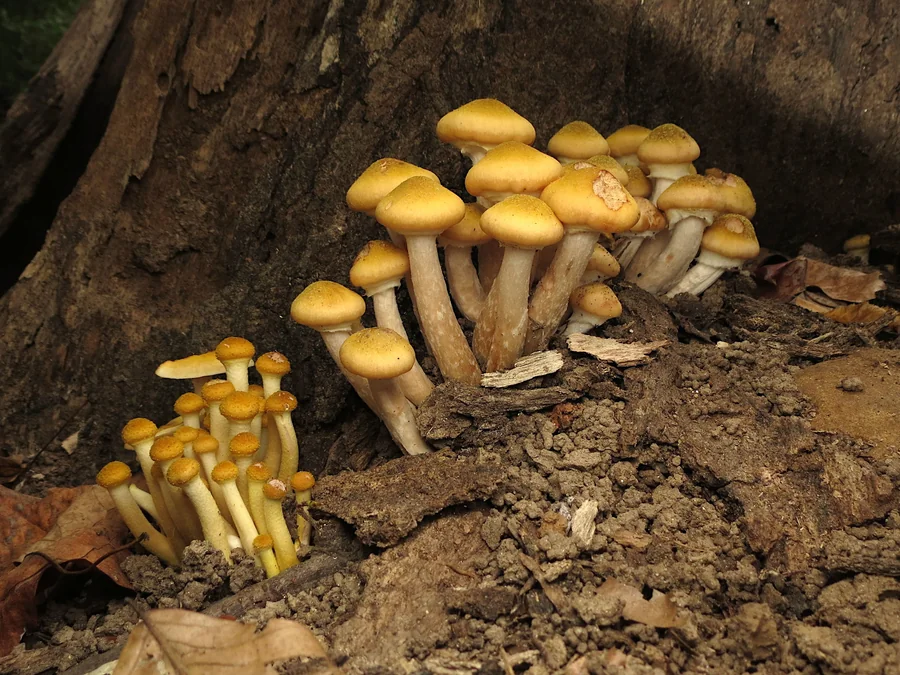
Honey fungus
Armillaria mellea · 蜜环菌
Common膨瑚菌科🔥 Edible With Preparation
Sources report it requires expert processing before it can be eaten; cases of poisoning from improper handling have been recorded.
The same species can be described differently across regions and stages of maturity, and countless look-alike species cannot be told apart by eye. Never use the information on this page to judge whether a real mushroom is safe to eat.
How to Tell
- Cap honey-yellow to brown, with fine scales at the center
- Stem with a prominent white membranous ring
- Grows in large clusters at tree bases and roots, often in extensive patches
ID notes are compiled by AI from public sources, not reviewed by a mycologist, for learning only — never a basis for foraging.
Basics
- Family
- 膨瑚菌科
- Hymenium
- Gills
- Grows On
- Wood
- How Big
- 3–12 cm (cap diameter)
- Encounter Rate
- Common
- Habitat
- Base of living trees and stumps, in large clumps
Easily Confused With
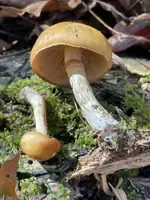 Funeral bellHoney fungus is large, clumped at tree bases, with a prominent white ring; funeral bell is small, with a thin ring that soon falls away.
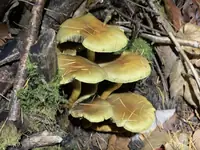 Sulphur tuftHoney fungus has white gills and a ring; sulphur tuft's gills go from yellow-green to purple-black and it has no true ring.
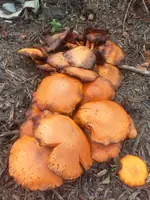 Spectacular rustgillHoney fungus has white gills and a white spore print; spectacular rustgill has rusty-brown gills, a rust spore print and a very bitter taste.
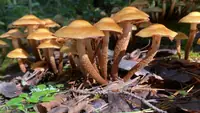 Sheathed woodtuftCap two-toned: dark brown at center, pale yellow at margin, more pronounced when wet
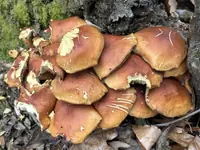 Brick capCap brick-red, darker at center, pale yellow at margin
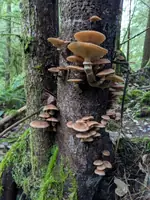 Humongous fungusCap brown, with small dark scales
Fun Fact
Its black root-like cords, called rhizomorphs, glow faintly green at night — one source behind old legends of 'foxfire' in the woods.