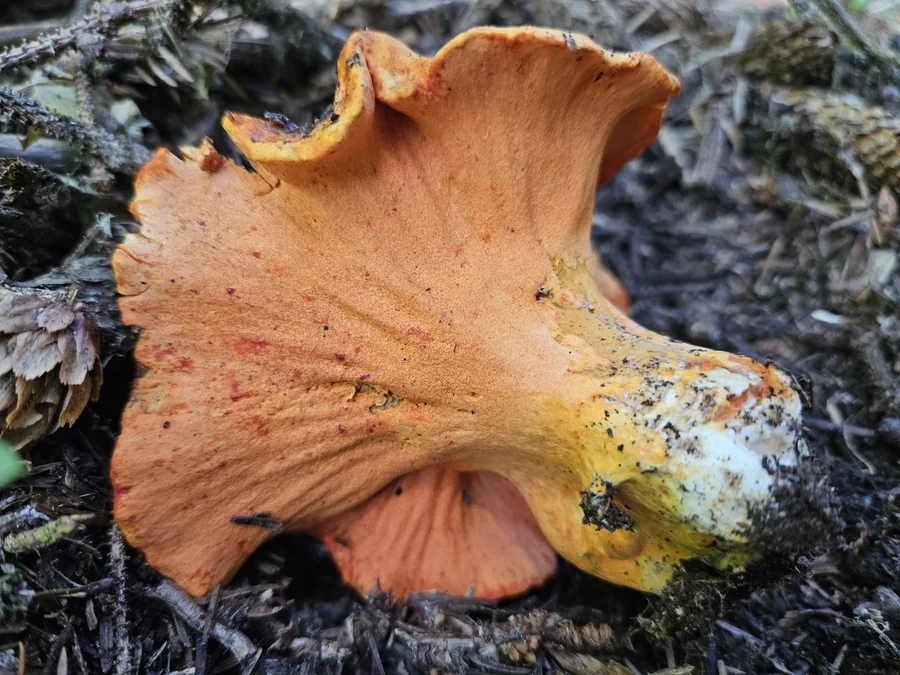
Lobster mushroom
Hypomyces lactifluorum · 龙虾菌
Common肉座菌科🍽 Reported Edible (Wild)
Reference sources describe this as an edible wild fungus. This guide provides no basis whatsoever for foraging or consumption.
The same species can be described differently across regions and stages of maturity, and countless look-alike species cannot be told apart by eye. Never use the information on this page to judge whether a real mushroom is safe to eat.
How to Tell
- Orange-red, contorted mass, colored like lobster shell
- A mold coating a host mushroom, surface rough and finely granular
- Gills fused into blunt ridges, the original mushroom's shape nearly unrecognizable
ID notes are compiled by AI from public sources, not reviewed by a mycologist, for learning only — never a basis for foraging.
Basics
- Family
- 肉座菌科
- Hymenium
- Smooth
- Grows On
- Parasitic
- How Big
- 5–15 cm (overall size)
- Encounter Rate
- Common
- Habitat
- Parasitic on fruitbodies of Russula and Lactarius
Fun Fact
It isn't really a mushroom's 'body' at all — it's a parasitic fungus that engulfs a host mushroom entirely, twisting it into a solid orange-red mass and even changing its flavor.