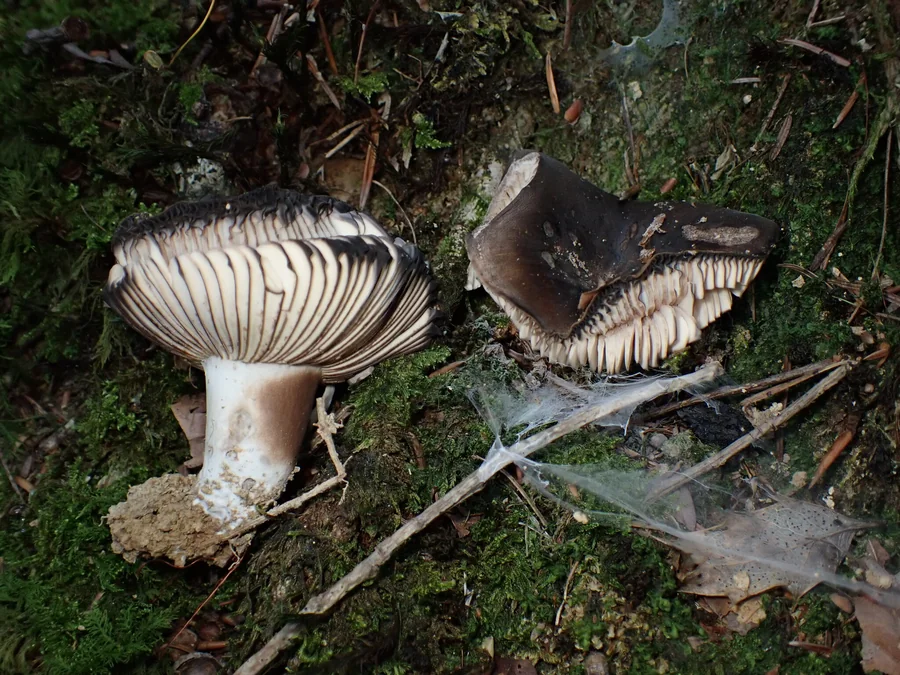
Blackening brittlegill
Russula nigricans · 稀褶红菇
Occasional红菇科🔥 Edible With Preparation
Sources report it requires expert processing before it can be eaten; cases of poisoning from improper handling have been recorded.
The same species can be described differently across regions and stages of maturity, and countless look-alike species cannot be told apart by eye. Never use the information on this page to judge whether a real mushroom is safe to eat.
How to Tell
- Cap grayish white to brown, bruising red then slowly blackening
- Gills thick and widely spaced, the most sparse of any Russula
- Old fruitbodies blacken entirely and can persist into the following year
ID notes are compiled by AI from public sources, not reviewed by a mycologist, for learning only — never a basis for foraging.
Basics
- Family
- 红菇科
- Hymenium
- Gills
- Grows On
- Mycorrhizal
- How Big
- 8–20 cm (cap diameter)
- Encounter Rate
- Occasional
- Habitat
- Ground in broadleaf woods
Easily Confused With
 Rank russulaBlackening brittlegill reddens then blackens when damaged, but slowly; rank russula has sparser, thicker gills and reddens faster.
 Japanese russulaBlackening brittlegill reddens then blackens when damaged; Japanese russula does not change colour.
 Brown roll-rimBlackening brittlegill has thick, widely spaced gills that turn red then black when damaged; brown roll-rim has crowded gills and a distinctly inrolled cap margin.
Fun Fact
A bruise turns red first, then black, until the whole mushroom looks charred; the deadly rank russula only turns red and never black — a critical difference.
More in this family
- Charcoal burner
- Green-cracking russula
- Hatsudake
- Indigo milk cap
- Saffron milk cap
- The sickener
- Woolly milkcap