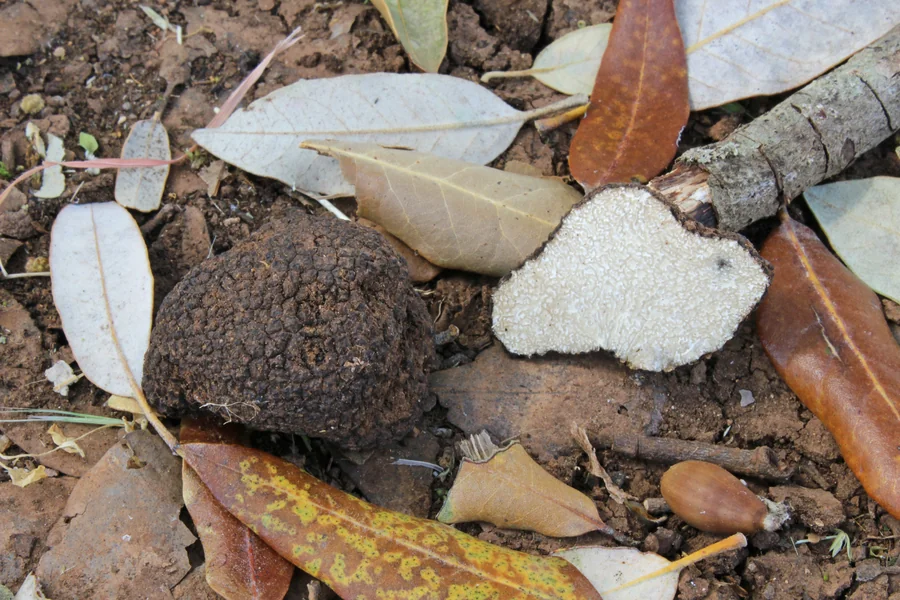
Summer truffle
Tuber aestivum · 夏块菌
Rarely Seen块菌科🍽 Reported Edible (Wild)
Reference sources describe this as an edible wild fungus. This guide provides no basis whatsoever for foraging or consumption.
The same species can be described differently across regions and stages of maturity, and countless look-alike species cannot be told apart by eye. Never use the information on this page to judge whether a real mushroom is safe to eat.
How to Tell
- Black and lumpy, surface with coarse, angular warts
- Interior pale brown with fine white veining when cut
- Grows in shallow soil at the roots of hardwoods
ID notes are compiled by AI from public sources, not reviewed by a mycologist, for learning only — never a basis for foraging.
Basics
- Family
- 块菌科
- Hymenium
- Gleba
- Grows On
- Mycorrhizal
- How Big
- 2–8 cm (overall size)
- Encounter Rate
- Rarely Seen
- Habitat
- Underground in European oak woods
Easily Confused With
 Chinese black truffleBlack and lumpy, warty surface, closely resembling the black Perigord truffle
Fun Fact
Its warty skin is larger and more angular than a black truffle's, the inside marbled a lighter brown with a milder aroma — and a price tag that's a fraction of the black truffle's.