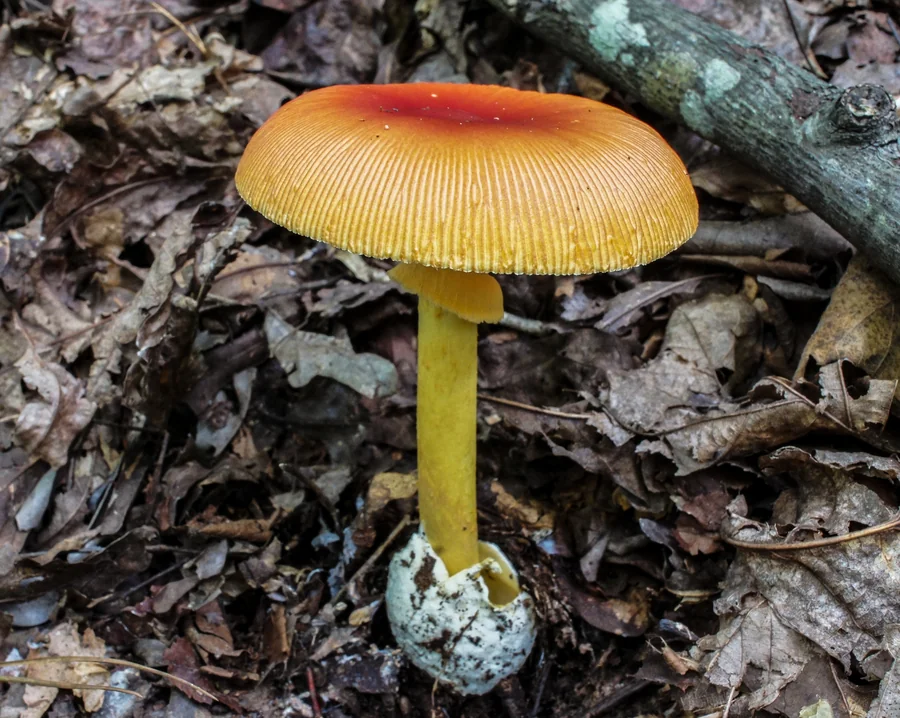
American Caesar
Amanita jacksonii · 杰克逊鹅膏
Occasional鹅膏科🍽 Reported Edible (Wild)
Reference sources describe this as an edible wild fungus. This guide provides no basis whatsoever for foraging or consumption.
The same species can be described differently across regions and stages of maturity, and countless look-alike species cannot be told apart by eye. Never use the information on this page to judge whether a real mushroom is safe to eat.
How to Tell
- Cap bright orange-red and smooth, margin distinctly striate
- Gills and stem yellow; stem with a yellow ring
- Base has a large, loose white sac-like volva
ID notes are compiled by AI from public sources, not reviewed by a mycologist, for learning only — never a basis for foraging.
Basics
- Family
- 鹅膏科
- Hymenium
- Gills
- Grows On
- Mycorrhizal
- How Big
- 6–12 cm (cap diameter)
- Encounter Rate
- Occasional
- Habitat
- Oak and pine woods of eastern North America
Easily Confused With
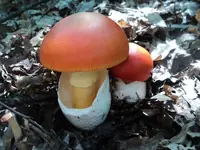 Caesar's mushroomCap orange-red and smooth, margin striate
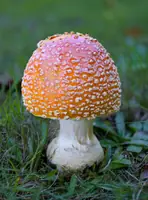 Fly agaricAmerican Caesar has a smooth cap with no white spots, a striate margin and yellow gills.
Fun Fact
North America's counterpart to Caesar's mushroom, with a distinctly grooved cap edge; deadly relatives in the same genus share its woodlands, so the risk in foraging is always there.
More in this family
- Death cap
- Destroying angel
- East Asian death cap
- East Asian yellow death cap
- False death cap
- Grisette
- Half-dyed slender caesar
- Panther cap
- Smith's amanita
- The blusher